Real findings. Real notes. Real rules.
De-identified examples from analyzed documentation. This is what review-before-signature looks like.
Four findings, as clinicians see them.
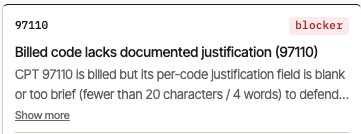
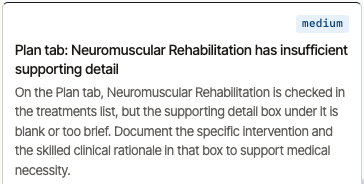
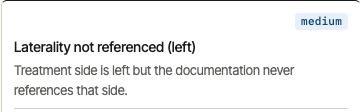
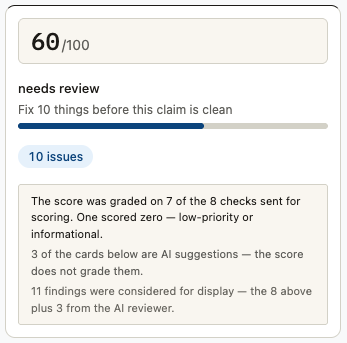
Unedited captures from Verq Check on de-identified documentation. The cards below them are illustrative examples of the same check families.
Undercoding
Evals billed below the complexity the note supports. A claim that pays less than it should looks clean to every scrubber — undercoding has no alarm. It never comes back as a denial; it just pays less, forever.
Eval billed at low complexity. The note documents two comorbidities affecting the plan of care and moderate clinical decision-making — consistent with 97162.
23 documented minutes billed as 1 unit. The documented time supports 2 units under the timed-code total.
Unsupported billing
Units, NCCI pairs, and modifiers — the ones that do come back.
6 documented minutes — below the 8-minute threshold. 1 billed unit not supported by documented time.
Bundled NCCI pair billed for the same session with no documentation supporting a distinct service. Without a 59 justification, the pair conflicts.
Audit exposure
Medical-necessity, visit-justification, and plan-of-care language — the “insufficient documentation” class that Medicare's error data ranks as the top cause of therapy denials.
Chief complaint states no clinical reason for care (“doing okay — just wants to get stronger”). The note does not justify the visit as written.
Recertification window has lapsed for the active plan of care. Visits documented after the certification period are exposed on review.
The whole story
Rules catch rule-breaks. The AI reviewer reads the note end to end — diagnosis to assessment to plan to billed codes — and flags where the story doesn't hold together. It reads a de-identified note: every identifier is stripped in the browser first, so no PHI leaves the browser — not even for the AI.
The diagnosis is right knee pain, but every goal and intervention in the plan targets shoulder function. As written, nothing in the plan of care treats the condition that justifies it.
The note bills skilled therapeutic exercise, but the narrative describes independently performed exercises with supervision. As written, the story doesn't demonstrate why a therapist's skill was required.
Each of these took a reviewer's knowledge and about 40 milliseconds.
Your clinic's notes deserve the same look.
Join the beta On a different EHR? Request it — we add EHRs by demand.