Catch it before Medicare does.
AI-assisted pre-signature Medicare documentation review for physical therapists using WebPT. Check potential issues with timed units, medical necessity, CPT coding, modifiers, and plans of care before signing. Every finding includes context for clinician review.
You find out about a bad note 60 days too late.
The denial letter arrives months after the visit. The addendum request arrives after the clinician has forgotten the patient. The eval that didn't support the complexity billed never arrives at all. By the time anything tells you the documentation had a problem, the note is signed, the claim is out, and the clinician has moved on.
Your clinicians aren't careless. The rules are intricate, they change, and you can't read every note yourself. So the only person checking their work is the reviewer.
And fixing it after the fact barely works: reworking a denied claim costs $25–$118 in staff labor (MGMA), against a Medicare therapy visit that pays about $100. That's why roughly half of denied claims are never fought at all — for a therapy visit, the appeal can cost more than the claim.
A reviewer beside every note, before it's signed.
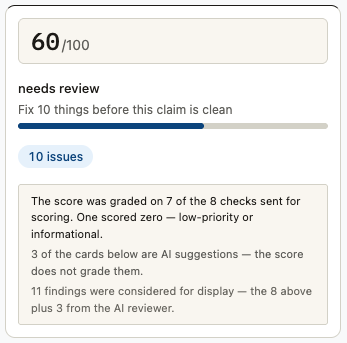
Verq is a browser extension — Chrome and Edge on desktop, with Safari on iPad coming to the App Store — that opens beside the chart. One click captures the note and reviews it the way a Medicare reviewer would:
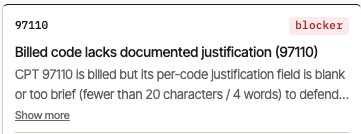
- 8-minute rule & unitsthe exact math, per code, per visit
- medical necessityscores the skilled-care case the note makes
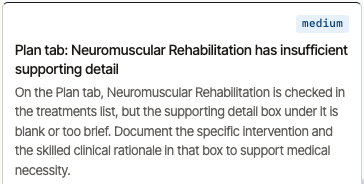
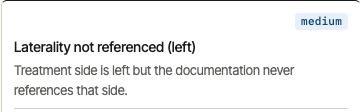
- modifiersmissing KX, GP/GO/GN, and NCCI pairs without a 59 justification
- plan of carecompleteness, certification, and recert timing
- undercodingevals billed below the complexity the note supports
- does the note justify the visit?flags chief complaints with no clinical reason for care
Then it reads the whole story.
second readRules catch rule-breaks. An AI reviewer catches everything between them: it reads the note end to end — diagnosis to assessment to plan to billed codes — and asks whether the story holds together. Does the diagnosis support the treatment? Does the assessment justify the plan? Does the note, taken whole, defend the visit? It also double-checks the rule findings themselves — confirming, adjusting, or rejecting them — so everything you see has been read twice.
And here's the catch that makes it safe: the AI never sees your patient. Every identifier — names, dates, MRNs — is stripped inside the browser before analysis. The AI reads the clinical story; the patient's identity never leaves WebPT. No PHI leaves the browser. How that works
Every finding explains the rule behind it and how serious it is — claim-blockers first. The note carries a score out of 100; fix the findings and watch it climb. Sign when it's clean.
Your EHR checks the claim. Verq checks the story.
EHR compliance checks are real and worth having. But they verify fields and arithmetic, and the deepest ones fire at the claim — after the note is signed. Medicare's own error data says therapy claims die on the narrative. Scrubber-clean isn't audit-proof.
| your emr | verq | |
|---|---|---|
| checks | fields & arithmetic | the clinical story |
| fires | at the claim — after signature | in the note — before |
| tuned for | getting the claim accepted | surviving the review |
Independent
An EHR grading its own homework isn't a review — and every documentation tool in rehab therapy is now EHR-owned and priced on a demo call. Verq's only job is your clinic's notes, at the price on this page.
On your WebPT, on your terms
Runs in the browser, on the logins you already pay for. Seats belong to the clinic — when a therapist leaves, reassign the seat to the next hire.
Private by architecture
Notes are de-identified inside the browser before anything leaves it. Our servers never see PHI — that's the design (patent pending), not a promise. Read how
A QC check, not a guarantee.
Verq checks documentation against published rules and tells you what a reviewer would question. It doesn't see your claims, your fee schedule, or your remittances, and it can't promise a note will be paid. What it can do is make sure the mistakes a reviewer looks for first — unsupported units, a missing modifier, an eval the note doesn't support — get caught in the panel, before signature, instead of by them, after.
Every finding explains its rule. Unit math shows its arithmetic. It's built to be checked.
How it works
- Start the trial
Choose your seat count, sign the click-through BAA, done in 5 minutes.
- Your clinicians install it
Chrome or Edge, two minutes each. No IT, no integration, no training. The iPad app is coming to the App Store.
- Open a chart and look
The score and the findings are right there in the panel. That's the whole demo, on your own notes.
FAQs
Doesn't my EHR have compliance checks?
Yes — good ones, for what they cover: unit math, NCCI pairs, KX thresholds, required fields. Those checks verify fields and arithmetic, and the deepest fire at the claim, after signature. Medicare's error data says therapy claims are denied first for insufficient documentation — the narrative. Verq reads the narrative, before you sign. Scrubber-clean isn't audit-proof; that's the layer Verq adds.
Will my clinicians actually use it?
It lives in a side panel next to the chart they're already in — one click to review, claim-blockers surfaced first, and a score that climbs as they fix things. Nothing new to learn, no workflow to change.
Can I see my clinicians' notes or findings?
No. Verq works entirely inside each clinician's browser — there's no admin console and nothing for you to administer. The note text stays in WebPT, and PHI never reaches our servers either. The architecture
Is it HIPAA-safe?
Notes are de-identified in the browser; PHI never reaches our servers. A BAA is included in signup. There's a one-page summary written to forward to whoever asks “is this okay to install?”
Does it tell me what a note is worth?
No. Verq doesn't see claim amounts or reimbursements and doesn't estimate them. It tells you which documentation rules a note doesn't meet, and how serious each finding is. What that's worth to your clinic is your math.
How do I know it's right?
Every finding explains its rule and its severity. Unit math shows its arithmetic. And it's tested against an adversarially reviewed clinical corpus before anything ships.
What about OT and SLP?
Fully supported — discipline tabs, GO/GN modifiers, discipline-specific codes and rules.
I use another EHR — will it work?
Yes — contact us at support@verq.ai and we can work with you to add support for your EHR.
I'm a clinician, not an owner.
On a different EHR? Tell us which one.
Verq Check reviews WebPT today. We add EHRs by demand — so if your clinic documents somewhere else, send us the name and you'll move it up the list. No commitment; just tell us where you work.
Learn the rules behind the review.
Guides to timed units, skilled-care justification and the documentation that supports an outpatient therapy record.
Medicare PT documentation
Evaluations, plans of care, treatment notes and progress reports.
The 8-minute rule
Understand timed service thresholds and common unit mistakes.
PT documentation audits
What to check before a signed note becomes an audit headache.
Prevent claim denials
Why therapy claims get denied and how to catch it before signature.
OT documentation
Occupational therapy records, the GO modifier, and medical necessity.
SLP documentation
Speech-language pathology records, the GN modifier, timed vs. untimed codes.
Your clinic signs dozens of notes a day.
Find out which ones a reviewer would question — before one does.
Join the beta limited beta · baa included · no phi leaves the browser